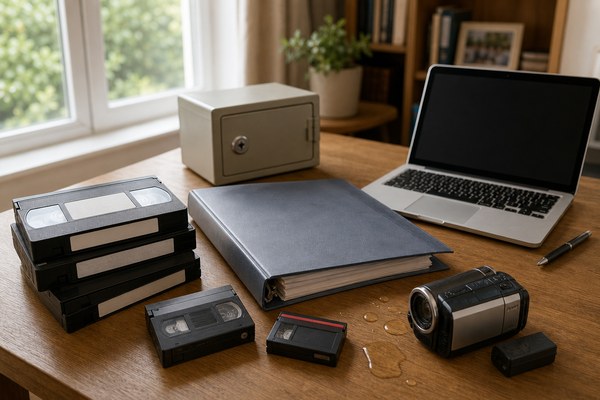
Does home insurance cover family video tapes after fire, flood or accidental damage?
Does home insurance cover family video tapes after fire, flood or accidental damage?
If you keep old VHS, Hi8, MiniDV or other family tapes in Burnley, Lancashire, you may assume your home insurance would automatically protect them after a fire, flood or accident. The reality is more complicated. In many cases, contents insurance may cover physical belongings damaged by an insured event, but that does not always mean the policy will fully account for the sentimental value, recovery costs or the difficulty of restoring irreplaceable family footage.
So, does home insurance cover family video tapes after fire, flood or accidental damage? The best short answer is sometimes, but you should never rely on that alone as your preservation plan. Insurance can help with financial loss in some situations. It cannot recreate one-off memories that were never digitised.
Why this question matters for Burnley families
A lot of family tapes in Burnley, Lancashire are still stored in lofts, spare rooms, cupboards and garages. That means they face two layers of risk at once. First, the tape format itself ages over time. Second, the storage location may expose it to fire, water ingress, accidental knocks or seasonal damp.
When people ask about insurance, they are usually trying to answer two different questions:
- Will the insurer treat the tapes as part of my insured contents?
- If the tapes are damaged, will the payout reflect the value of the memories on them?
Those are not the same question, and the second is where disappointment often begins.
What insurance may cover
Most household contents policies are designed around physical items and the cost of repair or replacement. If a flood, fire or another insured event damages a box of tapes, the insurer may view the cassettes as damaged possessions within the home.
Situations where cover may be possible
Fire damage
If tapes are physically damaged in a house fire, they may fall under contents cover, subject to policy wording and any excess.
Escape of water or flood
If an insured water event damages the tapes, the policy may respond to the physical contents loss.
Accidental damage extension
Some policies include accidental damage as standard, while others only include it as an optional add-on.
What insurance often does not solve well
Even when a policy responds, the payout may not reflect what matters most to the family.
| Issue | Insurance may help with | Insurance usually cannot restore |
|---|---|---|
| Burnt or water-damaged cassettes | Physical contents claim | Lost family footage and memories |
| Accidental drop or crush damage | Possible claim if accidental damage is included | The original one-off event on the tape |
| Damp-related decline over time | Often not sudden enough for a claim | Long-term deterioration already underway |
| Old, low-value media items | Modest replacement value | Sentimental or historical value |
A tape full of a child’s early birthdays may only be worth a few pounds as a used cassette in market terms. To the family, it may be priceless. Insurance and memory value rarely line up neatly.
The difference between sudden damage and gradual deterioration
This is one of the most important points. Insurance is often better at responding to sudden insured events than to slow decline. Fire and major water damage are easier to understand in policy terms than years of loft damp, seasonal condensation or ordinary tape ageing.
Examples
- A burst pipe ruins a box of tapes: this may be closer to an insurable event.
- Tapes slowly degrade in a damp cupboard over ten years: this is much less likely to be treated the same way.
- A family member drops a tape player and damages a cassette: this may depend on whether accidental damage cover applies.
That is why digitising before a problem happens is usually the smarter strategy.
Why preservation beats relying on a claim
Insurance is a financial tool, not a memory-preservation method. If the tapes are not digitised, the claim process may still leave you without the footage itself. Even when a damaged tape can be assessed, recovery becomes harder once heat, water or mould are involved.
For core service detail, see Burnley, Lancashire VHS to Digital for Safer Family Memory Preservation.
Tape to Digital UK also states a typical turnaround of 7 to 14 days after tapes are received, which makes proactive preservation much easier to plan than a post-disaster recovery attempt.
What should Burnley households do now?
If you have important tapes at home, the most practical response is to combine sensible insurance awareness with sensible archiving.
A better protection plan
Check your policy wording
Look for references to contents, accidental damage, flood, water escape and exclusions for gradual deterioration.
List what you have
If you have ten or twenty family tapes, note the formats and where they are stored.
Move the most important media first
Start with wedding videos, childhood footage and one-off family events.
Digitise before damage happens
Once the files exist digitally, you are no longer relying on a single physical cassette as the only copy.
Does the tape format change the answer?
Not much from an insurance perspective. VHS, VHS-C, Hi8 and MiniDV are all physical media items that can be damaged, but the emotional cost of loss is often much higher than the insurer’s replacement valuation. From a preservation perspective, however, format does matter because some formats are harder to access once old playback equipment disappears.
If your archive includes camcorder formats, the related Tier 1 posts on Hi8 and MiniDV are also relevant.
Frequently asked questions
Will insurance pay for the memories on the tape?
Usually not in the way families hope. A policy may deal with physical contents value, but sentimental value is much harder to compensate.
Is damp damage usually covered the same way as flood damage?
Not necessarily. Sudden insured water damage and long-term deterioration are often treated differently.
Should I digitise tapes even if I have good contents insurance?
Yes. Insurance can help with money in some cases, but it cannot recreate lost family moments.
What is the best next step for old tapes?
Check your storage conditions, review your policy wording and digitise the most important tapes before an avoidable problem becomes permanent.
Final answer
Home insurance may cover family video tapes after certain sudden events such as fire, flood or accidental damage, but it is not a reliable substitute for preservation. For Burnley, Lancashire families, the safer approach is to treat insurance as a backup for physical loss and digitising as the real way to protect the footage itself.
Want to secure family memories before damage or a claim becomes part of the story? Visit https://tapestodigital.uk/ to start your enquiry with Photo Hippo Ltd in Burnley, Lancashire.
