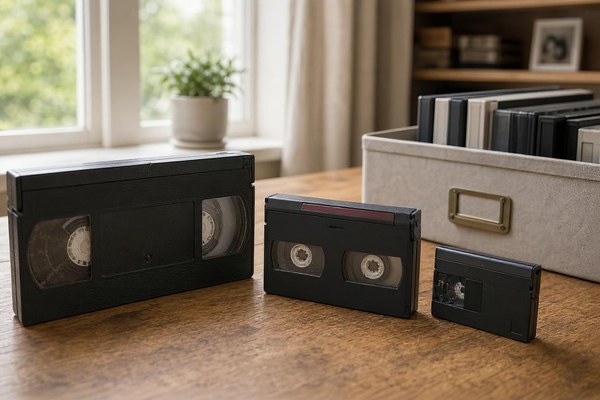
How long do VHS, Hi8 and MiniDV tapes last before they start to degrade?
How long do VHS, Hi8 and MiniDV tapes last before they start to degrade?
If you have old home videos stored in Burnley, Lancashire, it is natural to wonder how long VHS, Hi8 and MiniDV tapes actually last before they start to degrade. The honest answer is that all three formats have a limited life. Storage conditions, playback history and tape quality all matter, but none of these formats should be treated as permanent archives.
As a practical rule, many old video tapes begin showing age-related issues somewhere in the 10 to 30 year range, and some sources note that VHS can lose part of its signal quality within 10 to 25 years even when stored reasonably well. If your family recordings are from the 1980s, 1990s or early 2000s, they are already in the zone where preservation should be treated as urgent rather than optional.
Why old tape formats degrade
VHS and Hi8 are magnetic tape formats. MiniDV records digital data onto tape, but it is still tape, which means it still depends on a delicate physical strip, moving parts and ageing playback equipment. Over time, magnetic signal quality can weaken, lubricant can deteriorate, tape can stretch and damp environments can encourage mould or shell problems.
The biggest enemies of tape
Heat
Warm lofts, radiator cupboards and hot garages speed up deterioration.
Humidity
Damp storage can lead to warping, sticking and mould growth.
Repeated playback
Every extra run through an old machine creates some mechanical stress.
Poor storage
Tapes stored flat under weight, near dust or in mixed boxes without cases are at greater risk.
Typical lifespan by format
No provider can guarantee a precise expiry date for a tape, but you can still use sensible lifespan expectations.
| Format | General lifespan guide | Main risk over time | Why digitising matters |
|---|---|---|---|
| VHS | Often cited around 10 to 30 years | Signal loss, stretching, tracking issues | VCRs are disappearing and tapes keep ageing |
| Hi8 | Similar long-term ageing risks | Camcorder failure and magnetic degradation | Good family footage can become inaccessible fast |
| MiniDV | Better recording quality, but still tape-based | Playback hardware failure and tape transport issues | Digital-on-tape is still trapped on old hardware |
VHS
VHS is the format most people recognise, and it is also the one most likely to have lived in mixed household storage for decades. Some industry sources suggest VHS can lose up to 20% of upper-end video signal within 10 to 25 years, so visible decline is common.
Hi8
Hi8 often contains valuable camcorder footage from the 1990s and early 2000s. The picture quality may have been strong when recorded, but the format still depends on a working camcorder or playback deck. So even if the tape itself seems stable, access can vanish when the hardware fails.
For format-specific help, see Burnley, Lancashire Hi8 to Digital to Protect Ageing Camcorder Recordings.
MiniDV
MiniDV is already digital in the sense that it stores digital video data, but it is not immune from age. The recording still sits on a physical cassette and still needs the right equipment to be read. Many families discover that the bigger issue is not image decay first, but a missing charger, broken camcorder or outdated connection method.
For related guidance, read Burnley, Lancashire MiniDV to Digital for Easier Viewing and Backup.
How to tell if your tapes are already degrading
Sometimes the warning signs are visible. Sometimes they only appear during playback.
Common physical signs
- Dusty or brittle shells
- Labels falling off
- A musty smell from loft or garage storage
- Visible mould or residue inside the cassette window
- Warping, cracks or stiff reels
Common playback signs
- Picture flicker or tracking lines
- Dropouts or flashes across the screen
- Muffled, wobbly or distorted audio
- Tapes that stop, drag or eject badly
- Inconsistent playback between one machine and another
If you notice any of these issues, it is usually wiser to stop repeated testing and move toward professional transfer.
Where Burnley storage conditions make things worse
A lot of family media in Burnley, Lancashire is stored in lofts, spare rooms, garages or under-bed boxes. The storage space matters just as much as the tape format. A cool, dry cupboard inside the main house is far better than a hot attic or damp outbuilding.
Better storage guidance
- Store tapes upright.
- Keep them dry and cool.
- Avoid unnecessary test playback.
Should you wait until a tape shows problems?
No. The best time to digitise is before the tape becomes hard to play. Once a tape reaches the point of obvious damage, recovery can become slower, more expensive and less predictable. Preservation is easier while the tape still plays well.
That is especially true for Tape to Digital UK customers, because the service already offers UK-wide postal handling, careful returns and a typical turnaround of 7 to 14 days once tapes are received. If the goal is to keep family memories safe, it is better to act while the workflow is straightforward.
What happens after conversion?
Once VHS, Hi8 or MiniDV is transferred to digital files, you are no longer depending on one ageing tape or one piece of outdated hardware. You can back up the files, copy them to relatives and watch them on modern devices.
A sensible archive routine is:
- Keep one working copy on your computer.
- Make one extra copy on an external drive.
- Add an off-site or cloud copy if possible.
- Keep the original tapes until you confirm everything is present.
Frequently asked questions
Do all tapes go bad after exactly 30 years?
No. Tape life varies by brand, storage conditions and playback history. But 30 years is a useful warning point, not a guarantee of safety.
Is MiniDV safer because it is digital?
MiniDV can preserve strong picture quality, but it still depends on tape and old hardware. If the camera or deck fails, access becomes a problem even when the recording is still there.
What storage conditions are best?
Cool, dry, stable indoor storage is best. Damp garages, hot lofts and direct heat are all risky.
What is the safest next step if my tapes are important?
Convert them before obvious failure starts. That gives the best chance of a smooth transfer and a clean digital archive.
Final advice
VHS, Hi8 and MiniDV tapes do not last forever. If your recordings are already twenty years old or more, the safest assumption is that the clock is ticking. In Burnley, Lancashire, the smartest move is to digitise important tapes while they still play, rather than waiting for a problem to force the decision.
Want to protect ageing home videos before the quality drops further? Visit https://tapestodigital.uk/ to start your enquiry with Photo Hippo Ltd in Burnley, Lancashire.
