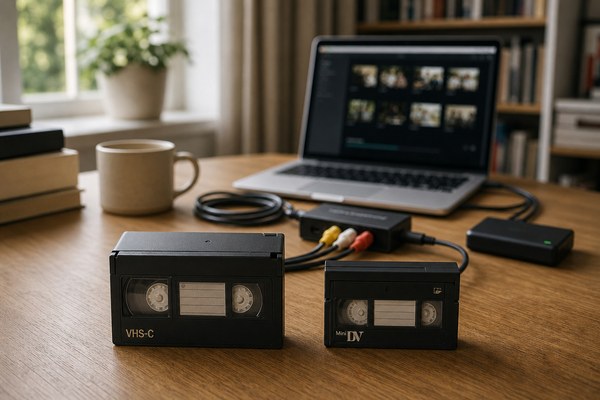
VHS-C vs MiniDV: which old camcorder format is easier to convert today?
VHS-C vs MiniDV: which old camcorder format is easier to convert today?
If you are sorting old camcorder tapes in Burnley, Lancashire, one practical question often comes up fast: is VHS-C or MiniDV easier to convert today? Both formats were widely used for family events, holidays and home movies, but they create different challenges during digitisation.
The short answer is that VHS-C is often simpler to explain, while MiniDV is often more straightforward once the right playback setup is available. In real life, the easier format depends less on the label on the cassette and more on tape condition, surviving hardware and the output you want.
What makes VHS-C and MiniDV different?
VHS-C is a compact analogue camcorder tape related to standard VHS. MiniDV is a small digital video tape format. That difference shapes the transfer process.
VHS-C
VHS-C was designed for smaller camcorders but still belongs to the VHS family. Many people remember using an adapter so the tape could play in a VCR.
MiniDV
MiniDV stored digital video data on tape. That gives it a different technical profile, but it still depends on ageing camcorder or deck hardware and is still trapped on a physical cassette until transferred.
Quick comparison: which is easier today?
| Factor | VHS-C | MiniDV |
|---|---|---|
| Recording type | Analogue | Digital on tape |
| Common problem today | Missing camcorder or unreliable adapter setup | Missing camcorder, charger, cable or FireWire path |
| Playback risk | Adapter and VCR compatibility issues | Hardware access and connection issues |
| Output after transfer | Typically MP4 or similar digital file | Typically MP4 or similar practical file |
| Overall ease | Mixed; often depends on playback route | Mixed; often easier once proper equipment is available |
Why VHS-C can be awkward
At first glance, VHS-C looks easy because people assume an adapter solves everything. Sometimes it does. Sometimes it does not. A small cassette, an old adapter and an ageing VCR can produce a fragile chain with several possible failure points.
Common VHS-C conversion obstacles
The original camcorder is gone
Many households still have the tapes but not the device that recorded them.
The adapter may not be reliable
Even if the adapter still exists, old VCR tracking and transport quality can vary.
The format is often mixed up with others
People sometimes confuse VHS-C with Video8 or Hi8 until the tapes are physically checked.
For format-specific service details, see Burnley, Lancashire VHS-C to Digital Without the Original Camcorder.
Why MiniDV can be awkward
MiniDV has a different problem. The tape may hold excellent family footage, but the household often no longer has the charger, cable, camera or computer connection needed to access it. In other words, the recording quality may still be there, yet the path to playback has disappeared.
Common MiniDV conversion obstacles
The camcorder powers on no longer
A dead battery system or faulty transport can stop access completely.
The connection method is outdated
Older capture workflows often depend on connections modern laptops do not support directly.
The family assumes “digital” means “already safe”
It is still tape, so it still needs proper preservation and modern file delivery.
Related reading: Burnley, Lancashire MiniDV to Digital for Easier Viewing and Backup.
Which format is easier for a professional service?
For a specialist with the right equipment, both formats are manageable. The difference is mostly about workflow rather than whether conversion is possible. In many cases, MiniDV can be very clean to transfer once appropriate playback hardware is available. VHS-C can be just as successful, but the path through adapter, VCR or camcorder playback can sometimes be more variable.
A practical rule of thumb
- MiniDV is often easier once the right playback chain exists.
- VHS-C can be easier if the tape is clean and the playback route is stable.
- Neither is ideal for DIY if the footage is important and the hardware is uncertain.
Cost and timing considerations
Exact pricing should come from the current quote, but as a broad UK planning guide, tape conversion often falls somewhere around £8 to £20+ per tape, depending on format, condition and output. The more relevant issue is usually not a huge price difference between VHS-C and MiniDV. It is the hidden cost of delay, failed DIY tests or equipment you need to buy for a one-off project.
Tape to Digital UK states a typical turnaround of 7 to 14 days after tapes are received, which is often far more convenient than trying to rebuild a home camcorder setup.
Which format is easier for family use after conversion?
After transfer, the difference disappears for most households. Once the footage from either VHS-C or MiniDV becomes a modern digital file, it can be watched, copied and backed up in the same way.
What matters more than the source format
File format
MP4 or another practical digital output is usually what the family actually wants.
Naming and organisation
A well-labelled archive is much easier to use than an unnamed one.
Backup plan
A second and third copy matter far more than whether the original started life as VHS-C or MiniDV.
So which one is easier?
If the question is about specialist conversion today, the honest answer is that MiniDV is often slightly cleaner once the right hardware is available, while VHS-C can be more dependent on the playback path. If the question is about a household trying to do it themselves, both formats can become awkward quickly.
That is why most Burnley, Lancashire families are better off focusing on which archive should be preserved first.
Frequently asked questions
Is VHS-C harder than MiniDV to convert?
Sometimes. VHS-C often depends on adapter or playback compatibility, while MiniDV often depends on access to the right older hardware and connection method.
Is MiniDV already digital, so does it need less work?
It is digital on tape, but it still needs a proper transfer process before it becomes easy to watch and back up on modern devices.
Which format is safer to send to a specialist?
Both can be handled safely by a suitable service. The key is using a provider familiar with multiple old tape formats.
What should I do if I have both formats mixed together?
Group them carefully, keep the labels intact and get a quote for the full batch instead of treating them as separate projects.
Final answer
VHS-C and MiniDV are both highly convertible today, but MiniDV is often easier once the right playback setup is in place, while VHS-C can be more sensitive to how it is played back. For most Burnley, Lancashire families, the real goal is not proving which format wins on paper. It is getting the footage off ageing media safely and into a format the family can actually use.
Want help with VHS-C, MiniDV or a mixed camcorder archive? Visit https://tapestodigital.uk/ to start your enquiry with Photo Hippo Ltd in Burnley, Lancashire.
